




The train car

January 26th, 2012

What exactly was a long distance train like in the 1970s?

Each country in Europe had a national railroad (and possibly some private railroads as well). It was typically the national railroad that ran the long-distance trains and any international traffic.

German Railways Bm234 passenger compartment car floor planMost train cars used in long distance service were similar in layout: At the ends were vestibules with doors to the outside, as well as doors to allow passage to the next train car. A toilet and often a wash room were also located in the vestibule.

From the vestibule, you entered a corridor that ran down the side of the train car. From it you could enter any one of 9 to 12 compartments (the number depending on the car’s type). Older cars often had 8 seats per compartment, newer ones 6. The wall to the compartments had plenty of glass, although there were curtains that could be pulled if one didn’t want to be seen by everyone walking by (handy at night when trying to catch some shut-eye).

Sliding doors provided entry into the compartments. Right next to the door was a small frame with numbers. If a seat in the compartment was reserved, it would be indicated on a paper strip inserted into this frame. You learned to check for those things.

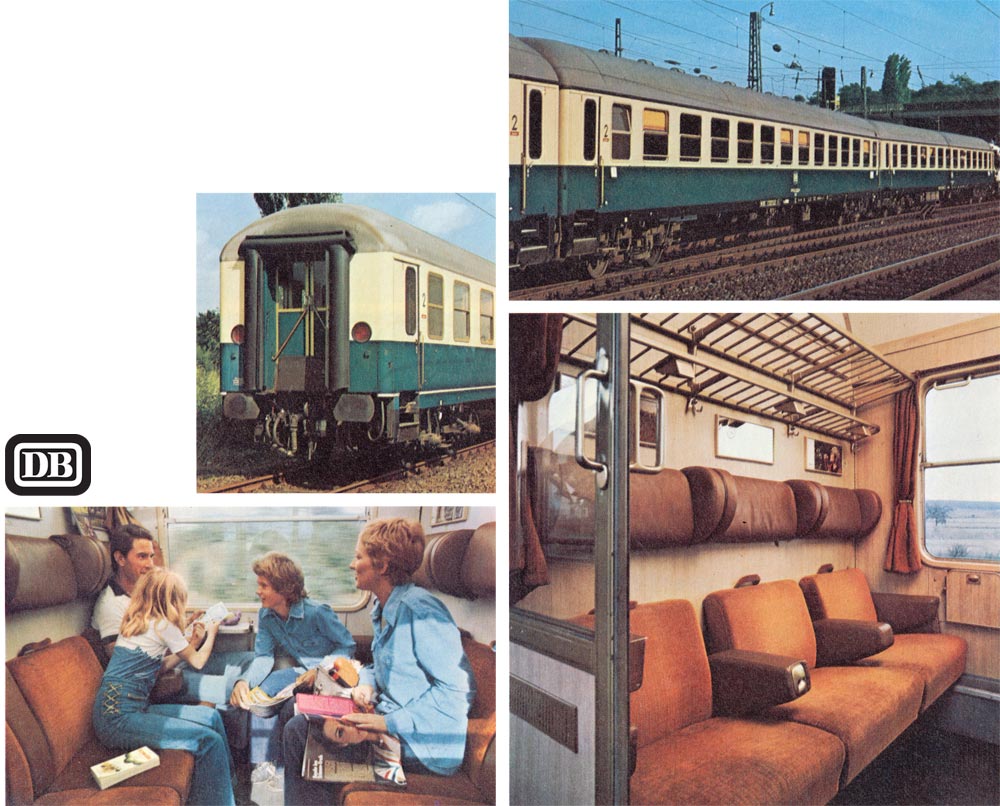
Pictures of exterior and interior of German train car Bm234Inside the compartment were either 2 benches or 6 individual seats. The quick lesson was benches are bad and individual seats are good. Those seats pulled out, allowing the traveler to enjoy a reclined position. 2 facing seats could be pulled out to provide a place to lie down. That way 3 people could comfortably lie down in a compartment for night travel. If there were 6 of you in there, you’d better be good friends as things got a bit snug.

Each seat had a headrest, often adjustable. The window seats and sometimes the aisle seats had small folding tables, just big enough for lunch.

Over the seats was a shelf for hats and small luggage items, and above it, a larger luggage shelf. After a while, you learned the right swing to hoist a fully loaded backpack up there without dropping it. There was also luggage space under the seats in many cars.

The windows back then opened, with the top half sliding down. You could hang out the window for fresh air or to wave goodbye to old or new friends as the train left the station. There was of course no air conditioning, so being able to open the window was a good thing.

During the trip, the compartment often became a world of its own. It was a place where great friendships were made, that lasted long after the journey was over. Or it was a place to get some rest, catch up on reading or just watch the world roll by outside the window. But after many cities, towns and youth hostels, there was something that felt like home about a train car compartment.

The Jet Age

November 16th, 2011

Pan Am 707 at Idlewild Airport 1961ABC’s new series Pan Am doesn’t at first appear to have much in common with train hikers and other young people making it to Europe on a dime in the ’70s. Yet, one reason many of them got inspired to travel was growing up with the Jet Age in the ’60s. When the sleek, gleaming jetliners took over from the old propeller planes, it wasn’t just a change of motive power, but it revamped air travel. The new planes traveled faster, smoother and brought more passengers to their destinations. The ’60s was a time when the jet networks grew to encircle the earth. You could fly to places like London and Paris, but you could also fly to Teheran and Karachi, Singapore and Sydney.

Pan Am, the TV show, captures that glamour, when girls wanted to be stewardesses and boys pilots, to soar into the sky, and to see the world. The Jet Age made air travel widely available and then when the odd man out, Icelandic, came along and provided the service cheaper — so cheap even a hippie could afford it — young people flocked to take the trip over to Europe.

But not all young people flew Icelandic. For many, having to go in and out of Europe via Luxembourg was too limiting. I know plenty of kids who flew open jaw, landing on one end of the continent and leaving from another. Or maybe an airline flying to the specific, desired region of Europe was more convenient.

I really don’t think the masses of college age kids from around the world would have been able to travel the way they did in the ’70s, had it not been for the Jet Age of the ’60s.

The funny thing is that even on the lowest fare back then, you still got good service. I remember an airline advertising that they wouldn’t fill the middle seat, so the persons in the inner and outer seats would have more space. Yeah, that wouldn’t happen today. The glamour and sense of adventure got lost, replaced by notoriously overbooked planes and harried cabin crews. Add to that seemingly endless security checks and somehow I don’t sense that airlines today really inspire young people to want to get out, travel, and see the world.

Train hiking and journaling

October 10th, 2011

Louis XVI is said to have written “Rien” (nothing) in his journal on the day the Bastille fell. Since he was the King, maybe he should have included more than just what happened in his little corner of the Palace of Versailles. But for all we know, it may have been a nothing day to him.

Fortunately my journal entries during months of travel around Europe in the 70s are much more extensive. Lots of things happened each day and at the end of the day or next morning there was usually time to write, sitting on a platform waiting for a train or on that train going somewhere.

Then it just seemed a good thing to do. Kind of fun. A bit of a chore some days. But I knew I was building memories and writing helps that process.

Later those journals got packed away in a box. Memories faded and blended. When thinking back, it got harder to remember. Did I really … or did …

In some cases I’ve been to the same place several times. So what happened which time?

Going back to read the journals straightened out a lot of that and also reminded me of things I’d totally forgotten. Even though the journal notes cover events from 35 or so years ago, when I read an entry, I can close my eyes and imagine being back there. And just as important for my writing: because of the journal notes, I can make sure to get details right, that would otherwise be forgotten, or at least be very hard to verify.

Summer of '75